

Valentine’s Day was this week, so I thought I’d write a love letter to batteries, the most potent technology in the economic war against fossil fuels. More than any other technology, batteries are powerfully undermining the economics and value proposition of fossil fuels.
Here’s why I think this, followed by some more battery info from my new climate tech and innovation guide.
Batteries, I love how you’re crushing fossil fuels:
❤️ You’re a force multiplier for renewables. Pair batteries with solar and wind, and their intermittent supply gets time shifted and fully utilized; their massive off-peak surpluses can be sold into markets at peak times and rates.
❤️ You do the same work as fossil, with a fraction of the fuel (or none). Because diesel generators run so inefficiently, for example, you can replace multiple diesel generators on a job site with mostly batteries, and burn far less fuel.
❤️ You enable energy independence and resilience without imports. People think fossil fuels enable resilience, because you can stockpile them. But the cost (and risk) of fuel imports dwarfs the cost of locally generated (e.g. solar plus storage) energy.
❤️ You eliminate huge capital costs like gas peaker plants. Building grid battery farms (and distributed virtual power plants) is a whole lot cheaper than building fossil power plants that only operate a few hours a day, a few weeks per year.
❤️ You unblock distribution bottlenecks, enabling more electrification. Adding battery storage is cheaper than adding costly transmission or distribution capacity that’s only necessary for peaks.
❤️ You can be swapped, breaking utilities’ distribution monopoly. Battery swapping’s already happening en mass in Asia (for e-scooters); this will extend to more and more applications and energy markets as battery densities keep improving.
❤️ The market’s already gobbling you up, and innovation’s accelerating. Because batteries are already in-the-money for so many applications (EVs, grid etc), scale economies have already kicked in; even more innovation is on the way.
And finally:
❤️ Most of you aren’t even connected yet! In 2023, 85% of new deployed battery capacity was for EVs, with 15% being grid batteries. But EV batteries sit unused most of the time, unable to provide backup power to homes or services to the grid. That’ll change bigtime as EV batteries become connected via two-way charging… goodbye diesel generators and gas peaker plants!
OK, enough lovey-dovey: now for some charts on batteries.
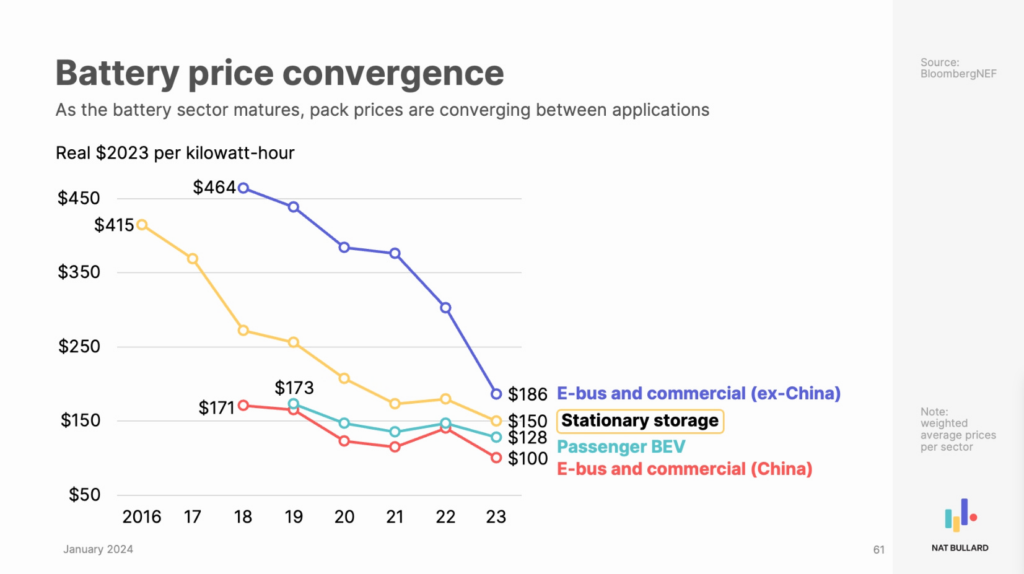
Prices keep dropping. Here’s a Bloomberg NEF chart via Nat Bullard’s excellent Jan 2024 Decarbonization presentation, showing how battery pack prices are dropping across categories, enabling batteries to further tighten their squeeze on fossil fuel economics:
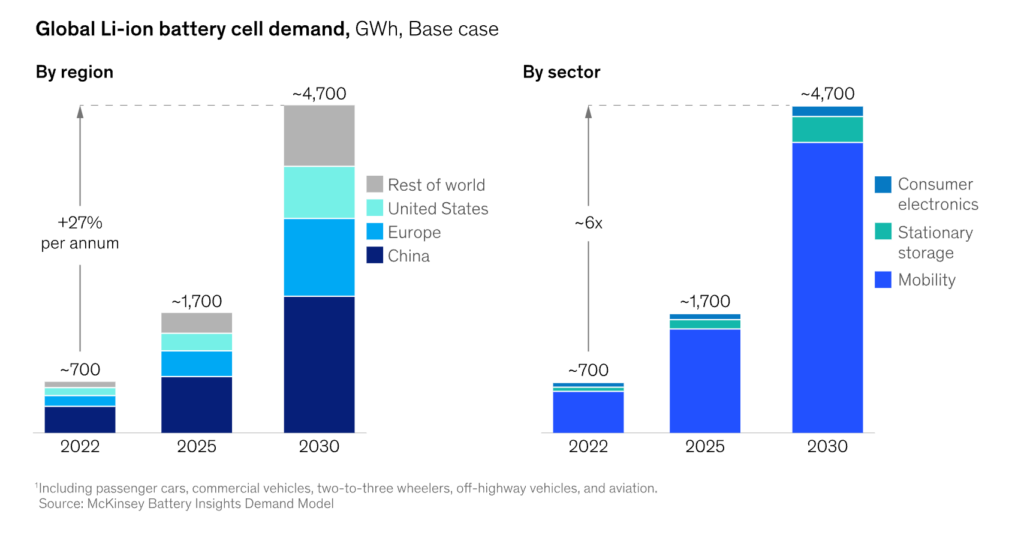
Demand keeps growing. Here’s a chart from McKinsey’s 2023 Battery Report showing that battery demand should keep growing fast for the next few years. Note that EV battery capacity demand (in gigawatt hours) consistently stays at 6-7x stationary/grid battery capacity demand.
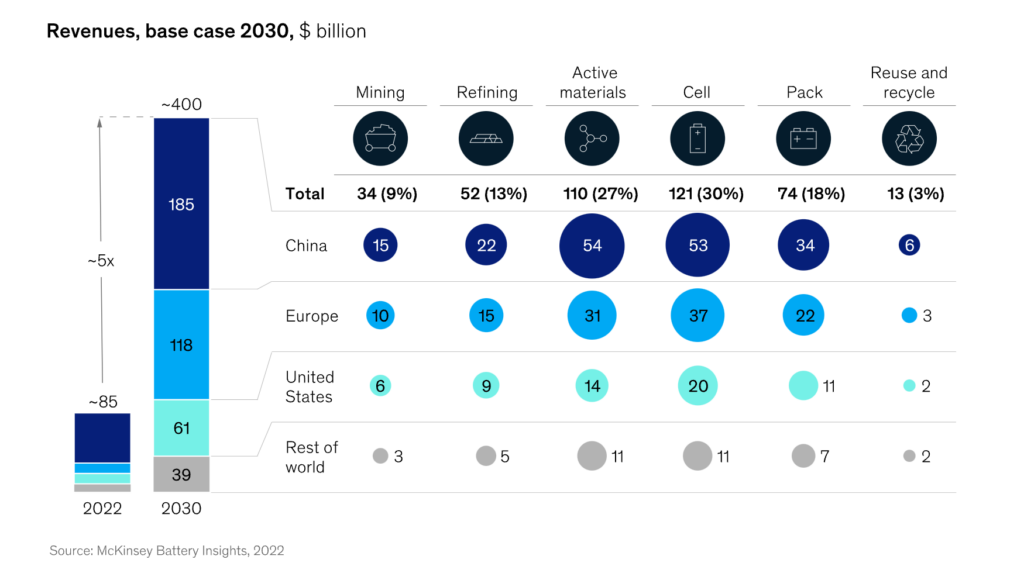
The supply chain’s expanding… and diversifying away from China? (maybe wishful thinking) This McKinsey chart shows the global battery pack value chain growing from about $100B today to $400B by 2030. Batteries are still a fraction of the global annual spend on the energy transition ($1.7T in 2023)… but the most leveraged fraction! Force multiplier!
Finally, one last geeky thing: Here’s the “Batteries and Storage” excerpt from my new guide, The Top 25 Most Promising Climate Technologies and Innovations:
Batteries & Storage
What’s exciting/promising:
– Batteries are a force multiplier for all other clean technologies.
– Continual improvements in cost, energy density and safety.
– Potential for further breakthroughs to accelerate electrification.
Overview:
Batteries are the all-around athlete of decarbonization. They increase wind and solar’s advantages on the grid over fossil fueled power plants. They increase EVs’ advantages over gas and diesel powered vehicles. And they keep getting cheaper and better. Each year brings improvements in battery chemistry and design, energy density, lifespan, safety, and cost. Yet some challenges persist, including China’s domination of the lithium battery supply chain, and the rare metals/minerals needed for production.

Open questions:
– How fast can new lithium-ion chemistries, or solid-state technologies, become deployable?
– Can a robust battery supply chain be developed outside of China?
Go deeper: McKinsey; FCAB; CTVC
Key concepts and terminology:
Anode/Cathode Anode is the negative electrode in a battery; Cathode is the positive electrode.
AC coupled A battery that takes AC current and converts it (via an inverter) to DC for storage, and then back to AC to discharge.
Battery cell The basic battery unit, with an anode, cathode and electrolyte. Aggregated in large numbers into battery packs.
Battery recycling Extracting as much re-usable material as possible (e.g. lithium, cobalt, nickel etc.) from end-of-life EV and grid batteries.
Continuous power How many kilowatts (kilo-volt-amps) a battery can output continually.
Cycle lifespan The number of times (cycles) you can charge 🔋 and discharge 🪫 a battery before it degrades.
DC coupled A battery that takes in DC current, and discharges DC current when needed.
Duration Today’s lithium ion batteries store four to eight hours worth of energy (for intraday use, e.g. on the grid).
Energy density How much energy a battery can store given its size and weight.
Flow batteries Long-duration grid batteries that store energy chemically as a bulk dissolved metal (e.g. iron) in large tanks of an electrolyte.
LFP lithium ion phosphate 🧪 LFP batteries are less storage dense than NMC batteries, but use fewer rare metals and are cheaper and less prone to fire.
Long duration storage Technologies that could store 10-200 hours of power, like metal-air, compressed air, flow, and gravity batteries.
NMC lithium ion chemistries 🧪 Nickel manganese cobalt batteries are energy dense, but have cost and fire risk issues and use problematic metals.
Peak (or max) power How many kilowatts a battery can output in short 💥 bursts.
Sodium ion chemistries 🧪 Batteries using cheaper sodium in place of lithium; now competing for both grid storage and EV applications.
Solid-state batteries 🚀 Batteries using thin layers of solid electrolytes to carry lithium ions between electrodes, enabling higher density.
Thermal batteries Heating or cooling a medium like water, sand, rock, bricks or molten salt to store energy for later.